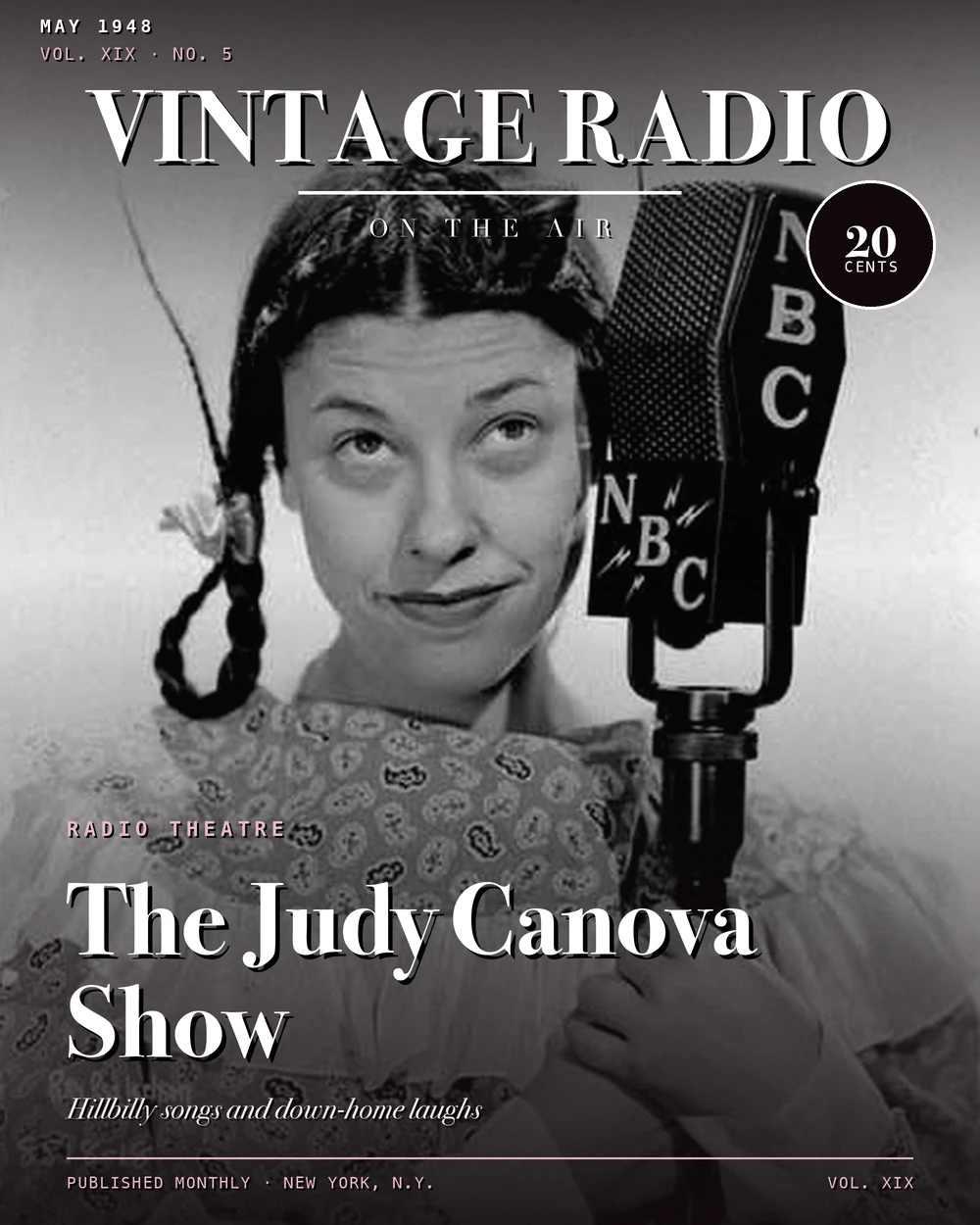
The Judy Canova Show
How It Got on the Air
The Judy Canova Show arrived in the summer of 1943 as a replacement program — the kind of slot that could disappear without notice if the ratings didn't hold. It didn't disappear. What started on July 6, 1943 as a CBS summer stand-in for The Al Jolson Show ran continuously, in one form or another, until May 28, 1953, eventually becoming one of the more durable comedy programs of the network radio era. Colgate had brought it in to fill Jolson's Tuesday-night 8:30 slot for the summer; when the run ended, Colgate decided not to bring Jolson back at all and stayed with Canova instead.
Judy Canova was born Juliette Canova on November 20, 1913, in Starke, Florida, the youngest of seven siblings. Her father was a businessman, her mother a singer. As a teenager she had ambitions toward serious music and hoped to attend the Cincinnati Conservatory of Music, but the Depression redirected the family toward performing together. The act started small — Florida theater dates, then the Village Barn in Manhattan — and was billed variously as the Three Georgia Crackers and the Three Canovas, with her sister Annie and brother Zeke. Rudy Vallee caught the act and put them on his Fleischmann Hour in 1933. By 1934 they were on Broadway in a Ziegfeld-associated revue called Calling All Stars. In 1939, the siblings became the first "hillbilly" act to appear on television, in an experimental NBC broadcast.
Canova had already been typecast as a hillbilly, hogcaller, and hayseed — what the trade press called the female answer to Bob Burns — well before she launched her own show. She had appeared on Paul Whiteman's Musical Varieties in 1936–37 and on Edgar Bergen's Chase and Sanborn Hour in the fall of 1938. By the time CBS and Colgate put her in her own half-hour slot, she had years of radio experience and an established character, even if she had never quite been able to outrun the typecasting.
The Show Itself
The fictional Judy Canova on the CBS version was a pigtails-and-calico bumpkin who had come to Hollywood from "Rancho Canova" in "Cactus Junction," sent to California in hopes her Aunt Aggie could help her become more sophisticated. When the show shifted to NBC — where it ran from January 13, 1945 to June 30, 1951 — the premise was revised: now Judy was a film actress living in California, already established, with a maid and a weekly radio program of her own. The hillbilly character remained, but she was no longer quite such a fish out of water.
Each episode followed a consistent structure: a monologue, a novelty song, a comedy skit, and a more serious vocal number. The monologues gave Canova room to spin tall tales about her pig Loverboy and a character called Cousin Ureenus, who was fond of chopped-liver ice cream. The launch was accompanied by a wave of publicity stills showing Canova armed with a shotgun and wolf traps, and the pigtails-and-calico look sparked a fad on college campuses in the fall of 1943. During the war, episodes closed with "Goodnight, Soldier" — "wherever you may be . . . my heart's lonely . . . without you." Afterward she switched to a nursery song that began "Go to sleep-y, little ba-by," with references to patty-cake and a shiny little pony; she said she remembered her own mother singing it to her, and she recorded it in 1946.
The show was created by J. Donald Wilson and produced initially by Diana Bourbon, who was succeeded by Carlton Alsop. Writers Fred Fox and Henry Hoople were the primary scripting team, joined at various points by John Ward, Bill Demling, and Arthur Phillips. Music across the run was provided by Opie Cates, Charles "Bud" Dant, and Gordon Jenkins. The Sportsmen Quartet joined in 1943 and backed Canova on most of her songs; they would later be familiar to listeners of The Jack Benny Program. The Southerners also sang on the NBC version. Announcers across the run included Ken Niles in the early-to-mid-1940s, Verne Smith in the mid-1940s, and Howard Petrie in the later period.
The Cast That Made It Work
The household at Rancho Canova was populated by a rotating ensemble, and several of those roles became as recognizable as Canova's own character. Verna Felton played Aunt Aggie, with Ruth Perrott taking on the role at various points; Felton later appeared in the show as a character named Miss Pierce as well. Ruby Dandridge played Geranium, the maid. Sheldon Leonard played Joe Crunchmiller, Judy's cab-driving boyfriend. Hans Conried played Mr. Hemingway, a house guest who complained about everything. Joe Kearns played the nonsensical Benchley Botsford. Gerald Mohr played the muscular Humphrey Cooper. Sharon Douglas played Brenda. Gale Gordon, George Niese, and Elvia Allman — who was heard regularly in a variety of roles on the CBS version — rounded out the cast at different points.
The most consequential cast member, in terms of what he brought to the show and what the show gave back to him, was Mel Blanc. He played three distinct characters: Pedro, the Mexican gardener-chauffeur; Roscoe E. Wortle, a fast-talking, obnoxious salesman; and Sylvester, a lisping character whose name and spray-when-he-talked voice Blanc later adapted for the Warner Bros. cartoon cat. Time magazine, in a profile calling Blanc radio's "one-man crowd," identified him on the show as playing Pedro, Salesman Roscoe Wortle, and "a chronic hiccougher." In later years on the show, Blanc and Canova performed a "Ma and Pa" sketch together in the second half of each episode. Blanc recycled his Pedro voice for Speedy Gonzales — who first appeared on August 29, 1953 in Cat-Tails for Two — and also for Jack Benny's character Sy, the Little Mexican, introduced in 1949. According to Blanc himself, the catchphrase "Thsufferin' Thsuccotash" used by the cartoon Sylvester was taken from the Roscoe E. Wortle character on this very show. The Pedro character had his own catchphrase: "Pardon me for talking in your face, senorita — thirty days hacienda, April, June, and sombrero."
The Numbers and the Sponsor
Colgate sponsored the show for its entire CBS run and continued through the NBC years until June 1951 — a long relationship for the era. A November 1949 script confirms the full billing as the Colgate-Palmolive-Peet Company, advertising Halo Shampoo and Colgate Dental Cream. Writer Fred Fox and musical director Charles "Bud" Dant worked on both The Judy Canova Show and a companion Colgate program, A Day in the Life of Dennis Day, simultaneously.
The ratings tell a story that doesn't match the show's critical reputation. According to researcher Jim Ramsburg, the show led its Saturday night NBC timeslot to eight Top 50 seasons. It finished second among Saturday night programs in both the 1948–49 and 1949–50 seasons — in both cases behind Colgate's Dennis Day program. It edged ahead of Dennis Day in the Saturday night Top Ten over the 1950–51 season. Then Colgate cancelled both shows on June 30, 1951 as network radio lost audience to television.
The 1945 introduction of the Hooper ratings system, which for the first time measured listening habits in small-town and rural markets, revealed that the Canova program was one of the top ten radio shows on the air. The St. James Encyclopedia of Popular Culture called Canova "one of the hidden gems of American popular culture, ignored by critics and overlooked by ratings systems that valued big city audiences yet beloved by audiences in smaller markets." That gap between critical notice and actual audience loyalty is one of the more interesting things about the show's run.
After Colgate pulled out, the show returned to NBC on December 29, 1951, running on a sustained basis on Saturdays at 9 until the following July, then returning in October with multiple sponsors — Emerson Drug, Smith Brothers, and General Motors — airing Thursdays at 10. That final run closed on May 28, 1953, and the program that replaced Canova on Colgate's earlier schedule was Colgate Theater of Romance, which dramatized famous love stories.
After the Radio Years
Canova's film career had run parallel to the radio show throughout its entire decade. She left Republic Pictures in 1943 over a salary dispute and signed with Columbia Pictures for three features: Louisiana Hayride (1944), Hit the Hay (1945), and Singin' in the Corn (1946). She returned to Republic in 1951 for color comedy features starting with Honeychile. During the war she sold U.S. War Bonds in her time away from the show and turned up frequently as a guest — Command Performance, Mail Call, Here's to Veterans, Burns and Allen, the Radio Hall of Fame, Screen Guild Theater, the Sealtest Variety Hour, and programs hosted by Abbott and Costello and Fred Allen.
Television parts came gradually. In 1954, she and her husband obtained a controlling interest in Camera Vision Productions, Inc., a Los Angeles company that had developed an automated camera reportedly capable of reducing production costs by as much as 50%. Variety reported that April that CBS planned a 90-minute program featuring her alongside stars of film and recordings; she turned up that July as a mystery guest on What's My Line. Her first dramatic television role was on Alfred Hitchcock Presents in 1960. In 1967 she played Mammy Yokum in an unsold NBC pilot adapted from Al Capp's Li'l Abner; in 1970 she starred in The Murdocks and the McClays, an ABC retelling of Romeo and Juliet set in the Virginia hills, which also failed to sell as a series. Guest appearances followed on The Red Skelton Show, The Steve Allen Show, The Colgate Comedy Hour, Matinee Theatre, The Mickey Mouse Club, Make Room for Daddy, and Love, American Style. Her final television appearance was in a 1977 episode of The Love Boat.
She is honored with two stars on the Hollywood Walk of Fame — one for film at 6821 Hollywood Boulevard, one for radio at 6777 Hollywood Boulevard. Judy Canova died of cancer on August 5, 1983, at age 69; her ashes were interred in the Columbarium of Everlasting Light at Forest Lawn Memorial Park in Glendale. Her daughter from her marriage to musician Filberto Rivero is actress Diana Canova, known for her role as Corine on the ABC sitcom Soap.
Approximately 105 episodes survive in audio form, totaling roughly fifty-one and a half hours of broadcast. A 1946 Columbia Pictures short documentary, Screen Snapshots Series 25 No. 9: The Judy Canova Radio Show, directed by Ralph Staub, filmed the NBC cast in production and preserves footage of Canova, Verna Felton, Mel Blanc, and Ruby Dandridge at work. Ben Ohmart's Judy Canova: Singin' in the Corn (BearManor Media, 2010) remains the most thorough account of her life and career.